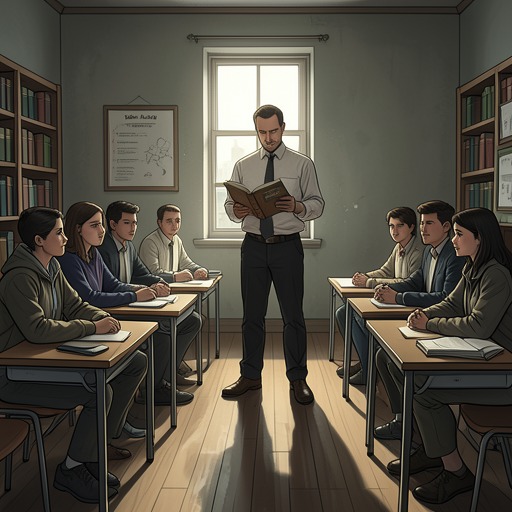
Make the best of a bad situation
I'd Like to Apologize to Every Teacher I Ever HadMake the best of a bad situation is presented as more than a cheerful slogan: it is a working ethic for surviving constraint without surrendering responsibility. In Tony Danza’s classroom, the phrase becomes a lesson in agency, a method for turning embarrassment or conflict into participation, and eventually a measure by which students describe what they learned. Its force comes from the tension between optimism and reality. Bad situations are not denied or magically solved; they are acknowledged as conditions in which the available choices are limited, but not meaningless.
Definition and Classroom Origin
The phrase receives its clearest definition during preparations for the New York field trip. The students learn that Principal Linda Carroll has decided to join them, and they respond with a chorus of protest because they regard the excursion as their own space and expect her presence to spoil its freedom. Rather than simply ordering them to accept the decision, Tony Danza identifies the moment as a teachable one. He connects the problem to the wider purpose of education: students often fail to see how school relates to life, and that disconnection allows them to conclude that school does not matter. The field-trip dispute supplies a small, immediate version of the larger questions explored in the English curriculum—friendship, heroism, humane judgment, and the obligation to walk in another person’s shoes.
Danza then asks the class to repeat the phrase, “Make the best of a baaaaad situation.” The elongated word turns instruction into comic performance. The students imitate sheep, bleating the phrase back and forth, and the joke temporarily displaces their irritation about the principal. The humor is not an escape from the lesson but its first demonstration: the class changes an unwelcome circumstance into a collective game, and the students participate in the transformation themselves.
Danza explains that a bad situation is one in which people dislike what is happening but have limited options. Such moments, he tells the class, will occur often, so the sensible response is to seek an advantage within the constraint rather than waste energy pretending the constraint does not exist. The students can reject Linda Carroll and hurt her feelings, or they can invite her and perhaps gain an ally in the principal’s office. Their written invitation is therefore both a social compromise and an exercise in practical reasoning. Emmanuel volunteers to deliver it, turning a reluctant concession into an act of diplomacy. Linda Carroll recognizes the students’ strategic politeness, yet she smiles and accepts the invitation.
From Disruption to Agency
The maxim gains significance because it operates against a background of pressures that are not comic and cannot be solved by clever phrasing alone. Tony Danza reaches teaching after the cancellation of his television talk show, the separation from his wife after twenty years of marriage, the departure of most of his children from the Los Angeles home, and a growing awareness of age and mortality. His father lived only to sixty-two, and the approach of sixty makes Danza feel that time may be running out. Those circumstances prompt him to reconsider his earlier ambition to teach and to pursue the classroom as a real contribution rather than merely a role he once played on television.
The principle also intersects with the strain of divided family obligations. Danza hesitates over buying a ticket home during the school year because the journey from Philadelphia to California would require a six-hour flight after school, only three days at home, and another long flight before Monday’s early wake-up. He worries that even while home he would be absorbed in his students, leaving little attention for his wife and biological children. When his elder daughter says, “Oh, that’s okay, Dad,” he cannot determine whether she is forgiving his absences, signaling that he has missed too much of her life, or recognizing that his work is important. His inability to read his own daughter while teaching students to read exposes the personal cost hidden inside his professional commitment. Making the best of a bad situation here does not mean discovering a painless solution; it means confronting competing duties without pretending that one cancels the other.
The same tension appears after Brittiny gives Danza information that he must report to her counselor. The report leads to her being moved to another foster home. Danza continues to spend time with her, but they never discuss the incident directly. He admits that this arrangement is easier for him and recognizes that he has “chicken[ed] out.” Days later, when Lynn Dixon asks whether he will return to teach the following year, he answers that at his age he is not sure he wants to care so much about anything. Her response—“That’s what it takes, baby. That’s what it takes.”—recasts emotional exposure as part of the work rather than as evidence that the work has failed. The maxim therefore carries an ethical demand: one must act within imperfect circumstances while accepting that action may bring further pain.
Conflict, Difference, and Limited Choices
The phrase is especially complicated in scenes shaped by racial tension and unequal opportunity. Matt’s repeated fights culminate in an assault by four African-American students, leaving him black-eyed and badly bruised. His father reports that Matt feels there are problems at Northeast High School, and Matt’s anger intensifies after the attack. Later, while leaving a school meeting, Matt’s parents become trapped behind a group of black girls whose crude language and racial epithets provoke a confrontation. Matt’s father emerges from the encounter convinced that his son’s complaints about the school are justified.
Danza warns the father not to tell Matt that he is right in that broad sense. He argues that the girls’ behavior must be understood culturally and that they are children shaped by what they see at home and in the media. The response does not erase the offensiveness of the encounter or solve the racial conflict; it attempts to prevent one violent episode from hardening into a total judgment about a school and its students. Matt is allowed to finish the year, but his father plans to send him to a Catholic school afterward. The maxim here is not a claim that every situation can be repaired inside the existing institution. It is a demand to distinguish among choices, interpretations, and consequences before reacting.
The school-uniform debate presents another version of the same problem. Paige objects to the idea that girls should be punished because other girls dress in distracting or sexualized ways. Her protest challenges the assumption that discipline can be made fair simply by applying a rule to everyone. The class argument reveals how a supposedly practical policy distributes responsibility and scrutiny unevenly, especially across gender. “Make the best of a bad situation” can thus be read critically: adaptation may help students navigate a flawed system, but it does not make the system just. Danza’s broader curriculum returns repeatedly to equal opportunity and to the ways people respond when they are denied a fair chance to succeed.
That social-justice dimension becomes explicit in the discussion of “Gangsta’s Paradise.” Danza uses the song to connect poetry with students’ lives and to continue the year’s inquiry into unequal opportunity. The students recognize the gangsta’s belief that disrespect must be answered violently because failing to defend honor invites attack. Their interpretation shows how a hostile environment can make destructive conduct appear rational or necessary. Danza’s own identification with the issue is personal: he knows that without extraordinary luck he might not have received a fair chance either. The maxim therefore asks for resourcefulness while preserving attention to the conditions that make resourcefulness necessary.
Recognition and the Students’ Verdict
The phrase ultimately passes from Danza’s instruction into the students’ own account of learning. After the final examination, every student passes the class, although Matt’s grade remains below what it should be; the students with IEP accommodations perform better than Danza had dared hope. The result brings him relief, exhilaration, and exhaustion because he realizes how much of his own identity and responsibility had been invested in the test. Their performance matters, but the essays that answer the question about the year’s most important lesson matter more.
Nakiya writes, “Make the best of a baaaad situation,” preserving the classroom’s comic spelling while claiming the maxim as her own. Al G writes, “Take part in your own education,” turning Danza’s insistence on participation into a student-authored principle. Ben-Kyle writes that “books are more than books. They are stories, too.” Together, the responses show the maxim embedded in a larger pedagogy: students are not merely expected to endure circumstances, but to interpret them, participate in their education, and find meanings that exceed the assigned text.
The phrase also becomes a retrospective description of Danza’s year. He enters Northeast High School as an actor attempting a late return to an abandoned vocational path, while the school presents him with unruly classes, racial conflict, student disengagement, emotional disclosures, and demands that extend beyond the lesson plan. He does not master every difficulty. He mishandles some personal situations, worries about his family, and doubts whether he can continue to care at the required intensity. Yet the students’ final essays confirm that the classroom has produced durable forms of understanding. The bad situation has not disappeared; it has been converted into shared language, effort, and recognition.